Your car won’t start, and it’s stuck somewhere inconvenient. You need a tow, but not all tow trucks are created equal. For many common situations here in San Diego, the speed and agility of a wheel-lift tow truck make it the perfect tool for the job.
What is a wheel-lift tow truck?
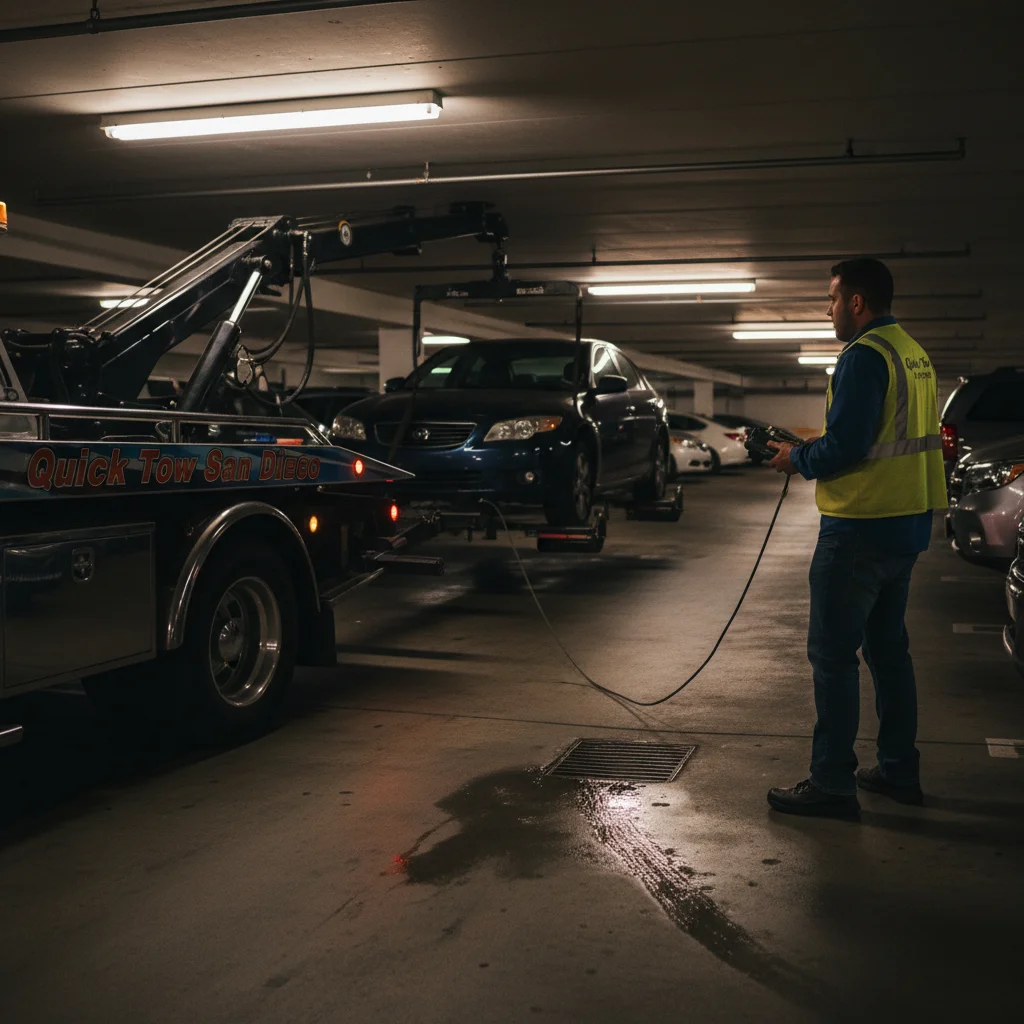
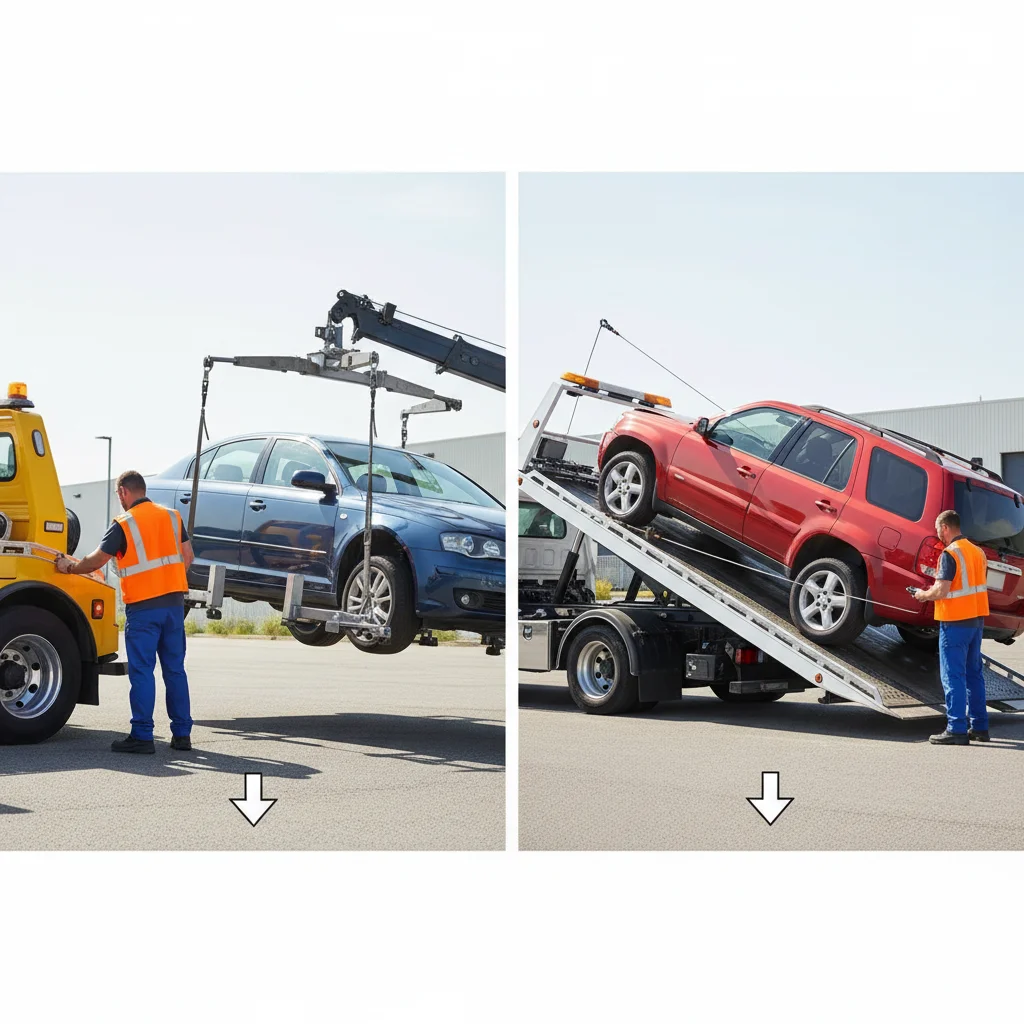
You’ve definitely seen them on San Diego’s roads. A wheel-lift tow truck uses a metal yoke that slides under the front or rear pair of wheels of your vehicle. A hydraulic lift then raises that end of the car off the ground, leaving the other two wheels to roll on the pavement as it’s towed.
This method is a major evolution from the older “hook and chain” trucks, which could cause damage to a car’s bumper and frame. The wheel-lift system only makes contact with the tires, making it a much safer and more secure option for the right kind of vehicle.
The key difference is how it compares to a flatbed tow truck. A flatbed has a large, flat platform that the entire vehicle is pulled onto and secured. All four wheels are off the ground. While flatbeds are essential for certain situations, a wheel-lift truck is often faster, more maneuverable, and more economical for many common roadside assistance calls. Think of it as a specialized tool: perfect for its intended purpose but not a one-size-fits-all solution.
The best situations for a wheel-lift tow
A wheel-lift tow truck is the go-to choice for many scenarios around San Diego County. Its efficiency and design make it ideal for specific types of vehicles and situations, getting you back on track quickly without unnecessary complications.
The most common use case is for two-wheel-drive (2WD) vehicles. If you have a front-wheel-drive car (like most modern sedans and crossovers), the truck’s yoke lifts the front drive wheels, and the rear wheels roll freely. For a rear-wheel-drive car (many sports cars, trucks, and older sedans), we lift the rear wheels. This prevents any wear and tear on your car’s transmission during the tow.
Wheel-lift towing is also perfect for short-distance tows. If your car breaks down in La Jolla and you just need to get it to a mechanic in Pacific Beach, a wheel-lift is a fast and cost-effective solution. They are quicker to deploy than flatbeds, meaning our driver can get your car hooked up and on its way in less time. They are also useful in recovery situations, like pulling a car out of a ditch or mud, before towing it away.
When a wheel-lift is a bad idea (AWD, EVs, luxury cars)
Knowing when not to use a wheel-lift is just as important as knowing when to use one. At Quick Tow San Diego, our priority is protecting your vehicle. Using the wrong equipment can lead to expensive damage, which is why we’re always transparent about the best method for your car.
Here are the primary situations where a wheel-lift is the wrong choice:
- All-Wheel Drive (AWD) & 4-Wheel Drive (4WD) Vehicles: This is the biggest red flag. Towing an AWD or 4WD vehicle with two wheels on the ground can severely damage the drivetrain and transmission. The interconnected system isn’t designed to have one set of wheels spinning while the other is stationary. For these vehicles, a [/services/flatbed-towing/](flatbed tow) is non-negotiable.
- Electric Vehicles (EVs): Many EVs have specific manufacturer guidelines that require flatbed towing to avoid damaging the electric motors or complex battery systems. A Tesla, for example, needs to be put into a special “Transport Mode” before being carefully loaded onto a flatbed.
- Luxury, Exotic, or Low-Clearance Cars: High-end vehicles and sports cars often have very little ground clearance. A wheel-lift system can risk scraping or damaging front splitters, bumpers, or underbody components. The gentle, controlled loading process of a flatbed is a much safer bet.
- Severe Accident Damage: If a vehicle has been in a serious accident, it may have damaged wheels, axles, or suspension components that prevent it from rolling safely. In these cases, the only secure way to transport it is on a flatbed.
Why it’s great for tight spaces like parking garages
One of the biggest advantages of a wheel-lift tow truck is its ability to go where larger trucks can’t. San Diego is full of tight parking garages, from the multi-level structures downtown and at the airport to the underground lots at malls like Fashion Valley or UTC. A standard flatbed truck is often too tall and long to navigate these spaces.
This is where the compact design of a tow truck for a parking garage really shines. Its lower profile and shorter wheelbase give it superior maneuverability. Our drivers can carefully navigate low-clearance ceilings, sharp turns, and narrow ramps to reach your disabled vehicle. Trying to push a dead car out of a winding parking structure is a frustrating and often impossible task. A wheel-lift truck can get in, secure your vehicle, and extract it with precision and safety.
The same principle applies to narrow residential streets in neighborhoods like North Park or Ocean Beach, where on-street parking can make it difficult for a large flatbed to operate. A wheel-lift can often access vehicles in these constrained areas more easily, making it the right tool for a quick and damage-free recovery.
How our drivers decide between wheel-lift and flatbed
When you call Quick Tow San Diego, you don’t have to be a towing expert. Our trained dispatchers and experienced drivers handle the decision-making process for you. Our goal is always to choose the safest, most efficient method for your specific vehicle and circumstances.
The process starts with your phone call. Our dispatcher will ask a few key questions:
- What is the year, make, and model of your vehicle? (This helps us determine the drivetrain).
- Is the vehicle all-wheel drive?
- What is wrong with the car? Can it roll?
- Where is the vehicle located? (e.g., “On the street,” “In an underground garage”).
Based on your answers, we can usually dispatch the correct truck from the start. When our driver arrives, they perform a final assessment of the scene. They’ll confirm the vehicle type, check for any potential damage, and evaluate the surrounding environment. Our priority is always safety, following best practices for securing vehicles as outlined by organizations like the NHTSA. If there’s any doubt about the safety of a wheel-lift tow, we will always opt for a flatbed. For a detailed comparison, you can read more about the differences in our guide to flatbed vs. wheel-lift towing.
Requesting the right truck for your situation
While our team will guide you, providing clear information when you call can speed up the process and ensure we send the right truck the first time. The more details you can give, the better prepared our driver will be.
When you call for a tow, try to have this information ready:
- Your exact location: Use a cross-street, address, or landmark.
- Vehicle details: Year, make, model (e.g., “2019 Toyota RAV4”).
- Drivetrain: If you know it, tell us if your car is front-wheel drive (FWD), rear-wheel drive (RWD), or all-wheel drive (AWD). This is often the most critical piece of information.
- The problem: “The battery is dead,” “I have a flat tire,” or “It was in an accident and the front wheel is damaged.”
- The car’s surroundings: “It’s on the second level of the Horton Plaza parking garage,” or “It’s in a narrow alley.”
Providing these details helps us match your need with the right equipment. If you have a standard 2WD sedan with a dead battery on a residential street, you can confidently ask for our wheel-lift towing service. If you have an AWD SUV or a low-slung sports car, we’ll know to send a flatbed. Clear communication gets you help faster.
When to call us
When you’re stuck and unsure what to do, a professional is your safest bet. Our experienced team can assess your situation over the phone and dispatch the right truck for the job, ensuring your vehicle is handled correctly and without risk of damage. Call us at (858) 923-5787 for a same-day estimate.