That sinking feeling is unmistakable. Your prized car, whether it’s a classic Porsche 911 or a brand new Lamborghini, has sputtered to a stop on the side of the 15. Now comes an even bigger worry: how do you get it moved without causing thousands of dollars in damage?
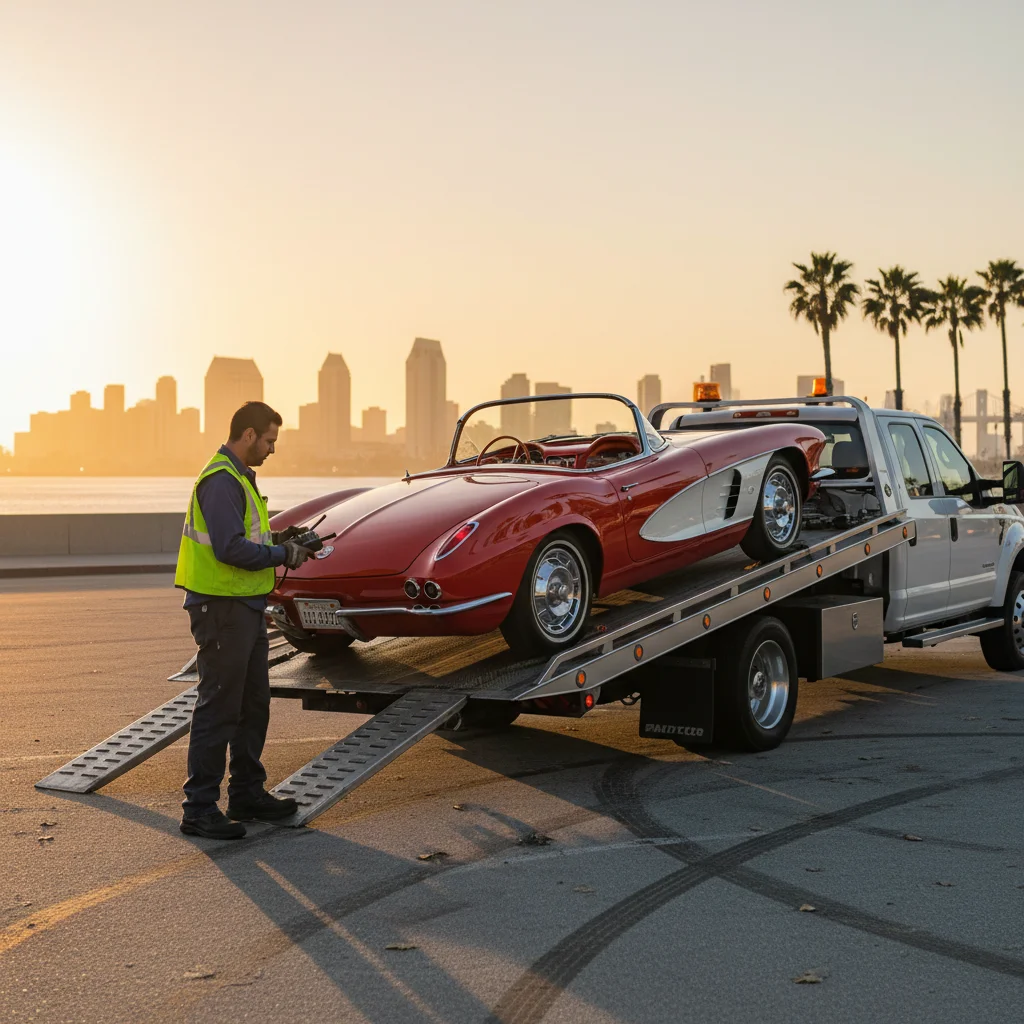
For any high-value, low-clearance, or cherished classic vehicle, there is only one right answer. You need a flatbed tow truck operated by a skilled professional. Anything else is a gamble you can’t afford to take.
Why standard tow trucks risk damaging exotic cars
The traditional hook-and-chain or wheel-lift tow trucks you often see are fine for many standard sedans and SUVs. But for a luxury, classic, or exotic car, they present a minefield of potential damage. These trucks lift a vehicle by its front or rear wheels, dragging the other two along the road. This method is completely unsuitable for specialty cars.
Here are the specific risks involved:
- Low-Clearance Damage: This is the biggest threat. Sports cars and classic cruisers are built low to the ground. The angled lift of a standard tow truck can easily cause expensive carbon fiber splitters, custom bumpers, side skirts, and exhaust systems to scrape against the pavement or the towing equipment itself. The sound of fiberglass or metal grinding on asphalt is one no owner wants to hear.
- Drivetrain and Transmission Strain: Modern all-wheel-drive (AWD) systems, common in luxury SUVs and performance cars, can be severely damaged if two wheels are spinning on the road while the other two are lifted. This can cause catastrophic failure in the center differential and transmission, leading to repairs that cost far more than the tow itself.
- Suspension and Alignment Issues: Suspending a vehicle by one end puts unnatural stress on its frame, suspension components, and alignment. This can throw off the precise geometry your performance car was designed with, affecting handling and tire wear.
- Body and Paint Damage: The metal yokes and chains used by older trucks can easily scratch paint, dent body panels, or damage custom wheels if not handled with absolute perfection. It’s a risk that simply isn’t necessary.
The fundamental difference in towing methods is critical. If you’re unsure which is right for your situation, it’s worth understanding the detailed breakdown of flatbed vs. wheel-lift towing. For a high-value vehicle, however, the choice is always clear.
What makes a flatbed tow truck safer for low-clearance vehicles
A flatbed tow truck eliminates virtually all the risks associated with standard towing. Instead of lifting one end of the car, the entire vehicle is loaded onto a solid, level platform. This method is essentially a private road that carries your car safely above the actual road.
The key to its safety lies in the loading process. The flatbed itself hydraulically tilts and slides down to the ground, creating a long, gentle ramp. A powerful winch with a nylon strap is then attached to your vehicle’s factory-approved tow point. An experienced operator will slowly and carefully guide the car up the ramp, constantly monitoring clearance on all sides. For extremely low vehicles, like a McLaren or a modified classic, operators use additional aids like wooden blocks or specialized “race ramps” to decrease the loading angle even further, ensuring no part of the undercarriage ever makes contact.
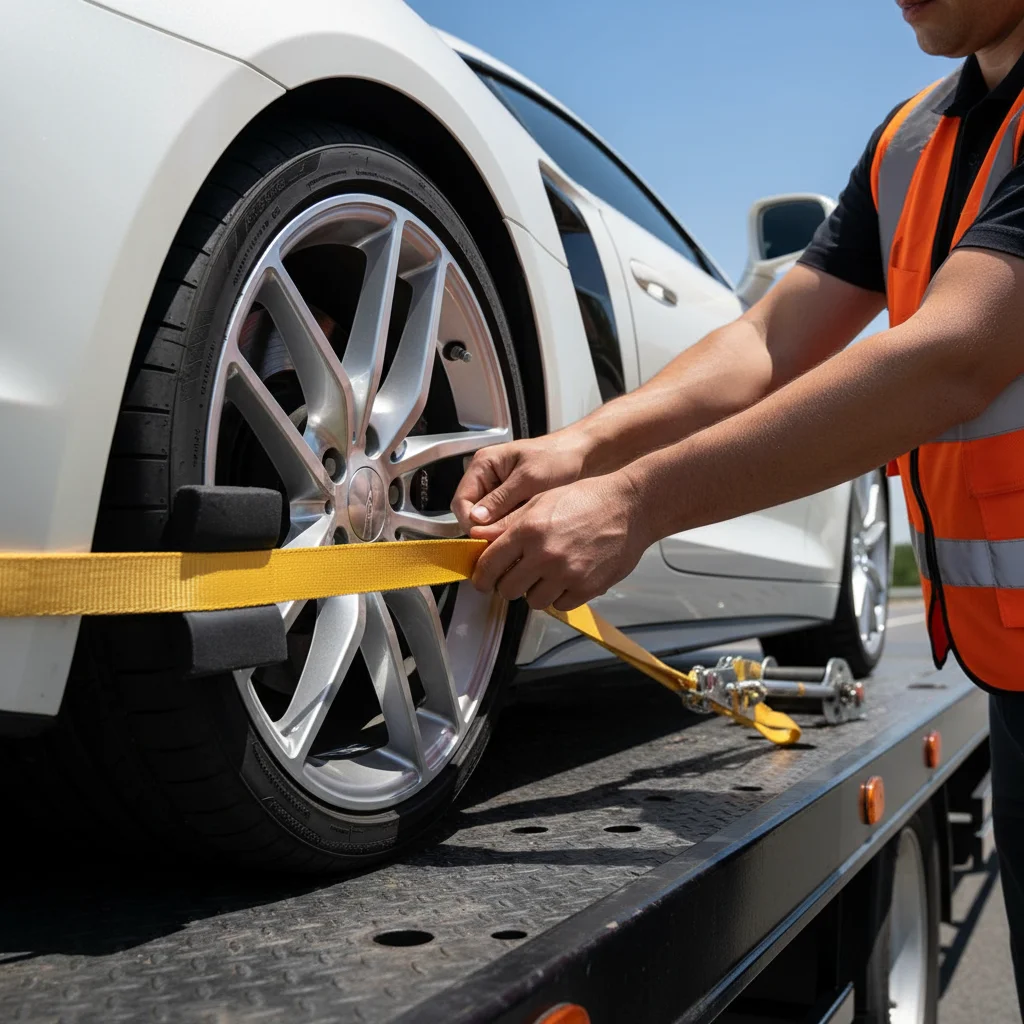
Once on the bed, your car rests on all four of its tires, just as it would in your garage. There is zero stress on the suspension, frame, or drivetrain. The vehicle is then secured using a four-point tie-down system with soft, wide straps that go over the tires. This method holds the car firmly in place without putting any pressure on the suspension or touching the delicate finish of your wheels. This level of care is the foundation of professional flatbed towing, making it the gold standard for luxury vehicle transport in San Diego.
Key questions to ask before you hire a towing company
Not all towing companies are equipped or trained to handle high-value vehicles. When you call for service, you’re not just ordering a truck; you’re entrusting a significant asset to an operator. Before you commit, take a moment to ask these critical questions to vet the provider:
- “Do you use a flatbed truck for exotic and classic cars?” If the answer is anything but an immediate “yes,” hang up and call someone else. This is the non-negotiable starting point.
- “Are your operators specifically trained for high-value and low-clearance vehicles?” Towing a Honda Civic is not the same as towing a Ferrari. The operator needs experience with proper winching techniques, calculating approach angles, and handling vehicles that may have unique electronic handbrakes or transport modes.
- “What type of straps do you use to secure the vehicle?” The correct answer is “soft nylon straps over the tires.” If they mention using chains on the frame or suspension, it’s a major red flag. This outdated method can damage undercarriage components and scratch your frame.
- “Can you confirm your insurance policy covers the full replacement value of my car?” Standard towing insurance may only cover up to $50,000. For a vehicle worth six figures, you need to know the company has adequate liability coverage in case of an unforeseen incident. Any professional company should be able to provide proof of insurance.
Asking these questions helps you find a true professional and gives you peace of mind. The side of a busy San Diego freeway is a stressful place to be, and it’s important to stay safe. As the NHTSA advises, you should stay in your vehicle with your seatbelt on if you cannot safely move away from traffic.
What to expect: the process of towing a high-value vehicle
When a Quick Tow San Diego operator arrives, you’ll see a meticulous, professional process unfold. We understand the anxiety you feel, and our procedure is designed to be transparent and safe from start to finish.
First, our operator will perform a thorough assessment. They’ll inspect your vehicle and the surrounding area to determine the safest loading angle, noting any potential hazards like curbs, steep inclines, or tight spaces.
Next, they prepare the truck. The flatbed is tilted and lowered, and if your car has particularly low clearance, special ramps or wood blocks will be laid down to create the gentlest possible slope.
The loading process is slow and deliberate. Using a soft winch strap attached to the manufacturer’s tow hook point, your vehicle is carefully guided onto the bed. The operator will be outside the vehicle, watching every angle to ensure no part of the bumper, spoiler, or undercarriage comes close to scraping.
Once loaded, securing the vehicle is the most critical step. We use an eight-point soft-tie-down system. Wide, non-abrasive nylon straps are looped over the top of each tire and tightened down to anchor points on the flatbed. This holds the car by its wheels, allowing the vehicle’s own suspension to absorb bumps during transit. We never attach hooks to your frame, control arms, or wheels.
During transport, your vehicle rides completely protected from road debris, potholes, and mileage accumulation. Upon arrival at your home or chosen repair shop, the process is reversed with the same level of precision. This specialized service is why owners across the county trust us for their exotic and classic car towing needs.
Average costs for exotic car towing in San Diego County
Towing a high-value vehicle is a premium service, and the cost reflects the specialized equipment, higher insurance coverage, and advanced operator training required. While it costs more than a standard tow, it’s a small investment to protect a much larger one. Expecting to pay the same as you would for a standard sedan is unrealistic and a sign of a low-quality provider.
In San Diego County, the cost for exotic car towing is typically broken down into a few components:
- Hook-Up Fee: This is a flat fee for the initial service call. For specialized flatbed service, this generally ranges from $150 to $350. This covers the operator’s time, the use of the specialized truck, and the careful loading/unloading process.
- Mileage Rate: After the initial hook-up, you’ll be charged a per-mile rate, which can range from $5 to $8 per mile.
- Additional Factors: Costs can increase due to certain circumstances. This includes after-hours or holiday service, difficult recovery situations (e.g., in a tight parking garage or off-road), or if the vehicle cannot be put into neutral, requiring the use of wheel dollies.
When you request a quote, a professional company will ask for your vehicle’s make and model, its condition, and its location to provide an accurate estimate. Be wary of any company that gives an unusually low, flat-rate quote without asking these questions. It often indicates they plan to use the wrong equipment or tack on hidden fees later.
When to call us
When your cherished vehicle needs to be moved safely and without compromise, you need a towing partner who respects your investment. For any luxury, classic, exotic, or low-clearance vehicle in San Diego County, a professional flatbed service is the only responsible choice.
Call us at (858) 923-5787 for a same-day estimate.