You’ve just pulled into your parking lot, ready to relax after a long day, only to find someone else’s vehicle occupying your assigned spot. It’s an incredibly frustrating experience, especially when it happens in a busy city like San Diego. Your first thought might be to call a tow truck immediately, but navigating the legalities of private property towing in California can be tricky.
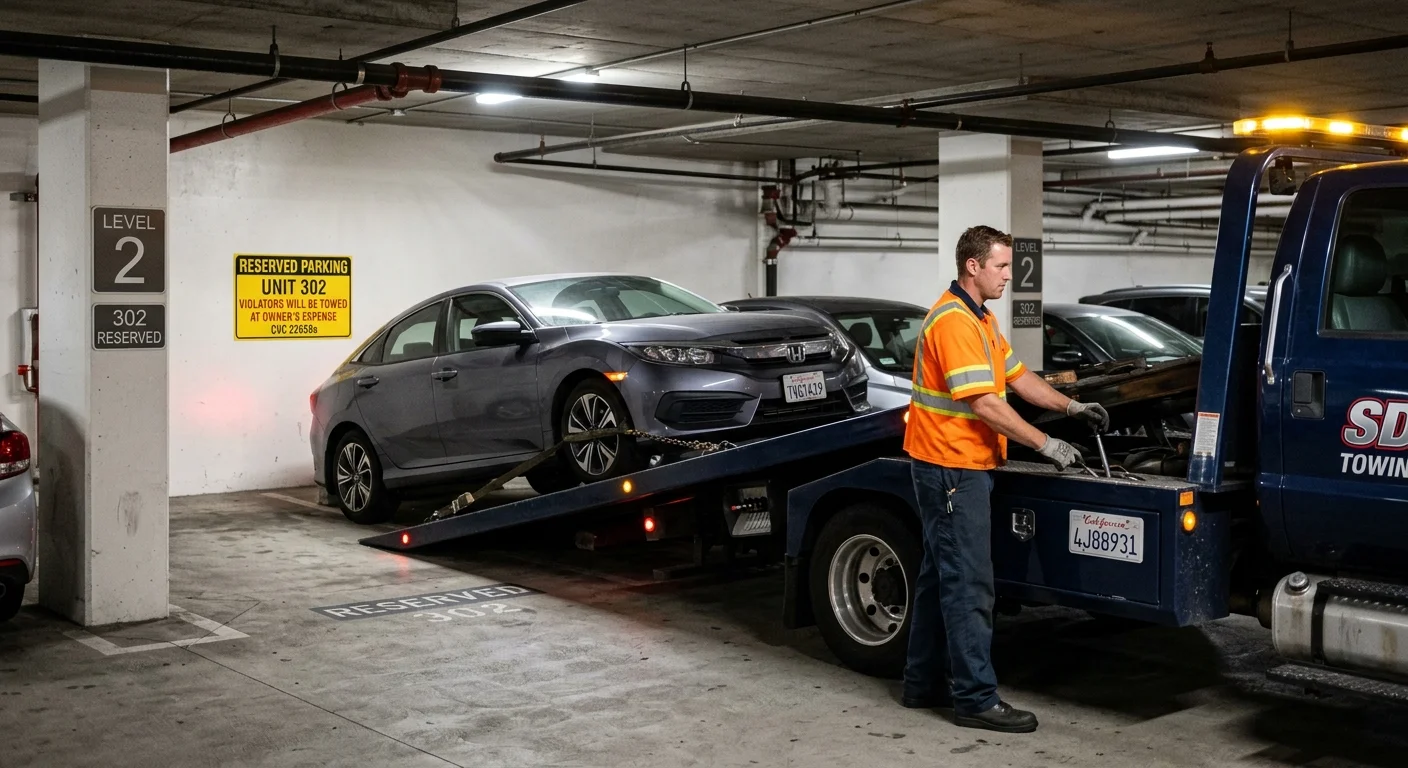
This guide provides clear, step-by-step instructions for what to do when an unauthorized car is in your parking space in San Diego, ensuring you handle the situation legally and effectively. We’ll help you understand your rights as a property owner or renter and how to get that car towed.
Is it legal to immediately tow a car from your private spot?
Yes, it is legal to tow an unauthorized vehicle from your private property in San Diego, but there are specific rules you must follow. California Vehicle Code (CVC) 22658 governs the removal of vehicles from private property. This code protects property owners while also preventing predatory towing practices. It’s crucial to understand these requirements before calling a tow truck. If you don’t follow the rules, you could be liable for illegal towing.
For instance, generally, you can’t just have a car towed away instantly without any prior notice or appropriate signage. The law usually requires specific conditions to be met, such as clearly posted signs warning drivers that unauthorized vehicles will be towed. These rules apply whether you own a single-family home with a reserved driveway spot, are a renter in an apartment complex, or manage a commercial property.
The good news is that if you meet the criteria, you can absolutely exercise your right to remove an illegally parked car. Quick Tow San Diego specializes in private property towing and understands all the local and state regulations, making the process smoother for you. We’re here to help you understand what’s required so you can act confidently and correctly. For a deeper dive into the specific sections of the law, you can read our detailed guide on CVC 22658 private property towing.
Step 1: Check for proper signage (the most important part)
This is the most critical step and often where property owners or renters run into issues. For a tow company to legally remove a vehicle from your private property, specific signage must be present and visible. CVC 22658 outlines these requirements precisely. Without correct signage, a tow company cannot legally perform the tow, and any attempt to do so could result in penalties for both you and the towing company.
What counts as proper signage in San Diego?
- Clear Warning: Signs must clearly state that unauthorized vehicles will be towed at the owner’s expense.
- Tow Company Information: The sign must include the name and telephone number of the towing company. This lets the vehicle owner know who to contact to retrieve their car.
- Location: Signs need to be prominently displayed at all entrances to the property and within the parking area, clearly visible to drivers. If it’s an assigned spot, the sign should be near that spot or cover the general area.
- Minimum Size: There are specific size requirements for the lettering on these signs. Typically, the letters must be at least 1 inch high.
- 24-Hour Posting: Signs must be posted for at least 24 hours before a tow can occur, unless the vehicle is blocking an entrance or fire lane, or is on a single-family residential property where the owner requests the tow.
If you don’t have proper signage, it’s often the first thing a reputable tow company will ask about. If your HOA handles parking enforcement in San Diego, they should have these signs in place. If not, you might need to work with your property management or HOA to get compliant signage installed before a tow can proceed legally. If the vehicle is blocking access, like in a situation where a car is blocking your driveway in San Diego, the signage requirements can be slightly different, allowing for quicker removal.
Step 2: Who to call (it’s not the police)
When you find an unauthorized vehicle in your assigned parking spot, your immediate instinct might be to call the San Diego Police Department. However, for private property towing, the police typically don’t handle the dispatch of tow trucks unless there’s a traffic hazard or a criminal element involved (like a stolen vehicle). Their role is generally limited to verifying that the vehicle is not stolen and that no crime is in progress.
Instead, you need to call a licensed towing company that specializes in towing from private property San Diego. Quick Tow San Diego is experienced in these situations. When you call us, we’ll guide you through the process and ensure all legal requirements are met. We’ll ask you a series of questions to confirm compliance with CVC 22658, especially regarding your signage.
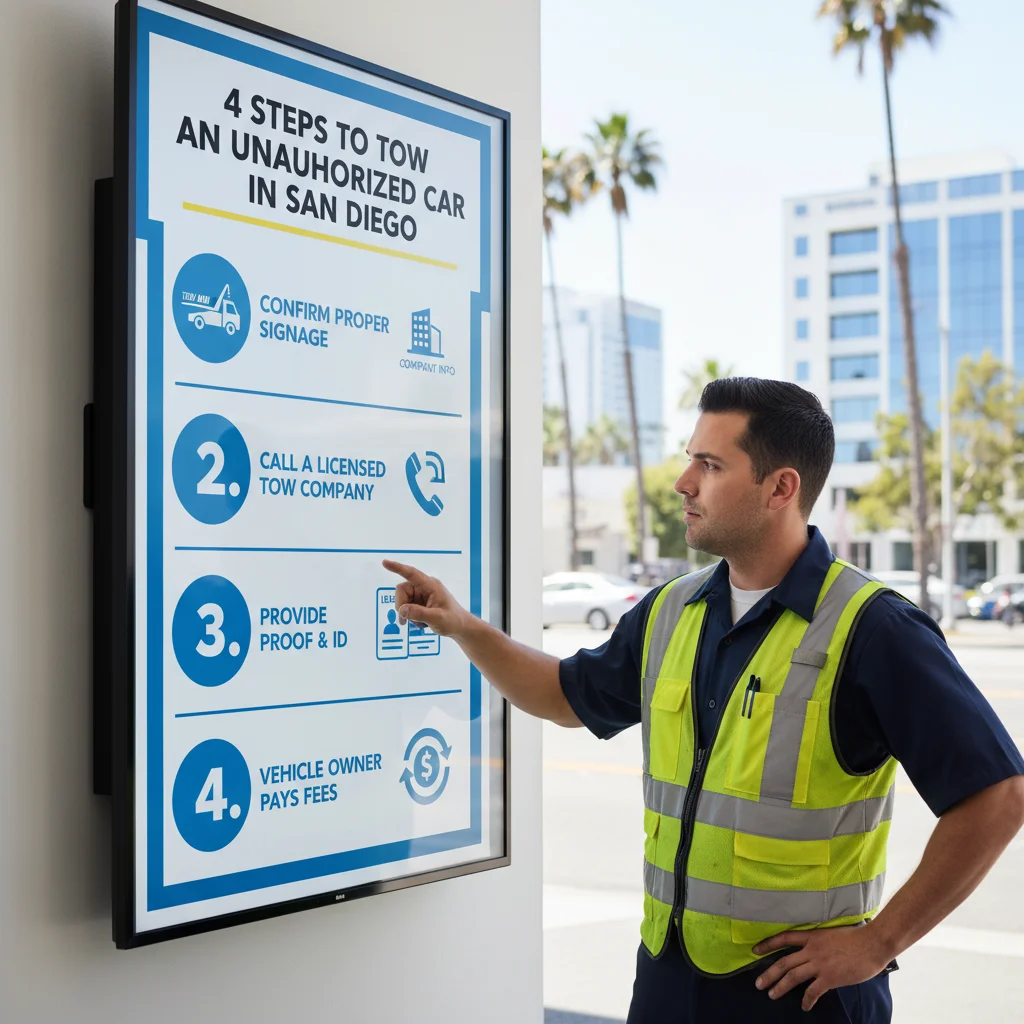
Calling the right company is crucial for a smooth and legal tow. A reputable company will prioritize compliance and ensure that the tow is performed without issues for you or the vehicle owner. Avoid any company that suggests circumventing the legal requirements, as this could put you at risk. We operate 24/7, so no matter when you discover an unauthorized car in your parking space, you can reach out for assistance. Our dispatchers are knowledgeable about San Diego’s specific towing regulations and can advise you on the next steps.
What the tow company will need from you as the property owner/renter
When you call Quick Tow San Diego to request a tow from your private parking spot, we’ll need certain information and documentation to proceed legally. This helps protect everyone involved and ensures compliance with CVC 22658. Having these details ready can significantly speed up the process.
Here’s what a legitimate tow company will typically require from you:
- Proof of Property Control: You’ll need to demonstrate that you have legal control over the parking spot. This could be a lease agreement (showing you’re a renter with an assigned spot), a property deed (if you’re the owner), or a letter from your HOA or property management. If you’re managing an HOA parking enforcement San Diego situation, you might need to provide proof of your authority to act on behalf of the association.
- Identification: We’ll need a valid form of identification from you to confirm your identity and ensure you’re authorized to request the tow.
- Vehicle Information (if possible): While not strictly required for the tow itself, providing the make, model, color, and license plate number of the unauthorized vehicle can help the tow truck driver quickly identify the correct car.
- Signed Authorization: The tow truck driver will require your signature on a specific authorization form at the time of the tow. This form confirms that you are requesting the tow and that you understand the terms. Do not pre-sign blank forms; always review and sign at the time of service.
- Confirmation of Signage: As discussed, we’ll verify that the necessary “No Parking/Tow Away” signs are correctly and visibly posted on your property. If they are not compliant, we won’t be able to proceed with the tow.
Our team will guide you through all these requirements, making sure you understand each step. We want to make the process as stress-free as possible while ensuring full legal adherence.
Who pays for the tow?
This is a common question, and generally, the answer provides some relief to the frustrated property owner: the owner of the illegally parked vehicle is responsible for all towing and storage fees. This is explicitly stated within California Vehicle Code 22658. The property owner or renter requesting the tow is not typically responsible for these costs.
When Quick Tow San Diego removes an unauthorized car from your spot, we will tow it to our impound lot. The vehicle owner will then need to contact us, pay the towing and storage fees directly to us, and present valid identification and proof of ownership to retrieve their vehicle. This system ensures that those who violate parking rules bear the financial consequences, not the individuals whose private property rights have been infringed upon.
However, there’s a crucial caveat: if the tow is found to be illegal because the property owner or renter did not follow CVC 22658 (e.g., inadequate signage, no authorization), then the property owner who requested the tow could potentially be held responsible for the towing and storage fees, and possibly face other legal repercussions. This is another reason why it’s so vital to work with a reputable towing company like Quick Tow San Diego, which prioritizes strict adherence to the law. We’ll help you confirm everything is in order before the tow, protecting you from potential liabilities.
Avoiding confrontation with the vehicle owner
Discovering an unauthorized car in your private parking spot can trigger strong emotions – frustration, anger, and a sense of violation. While it’s natural to feel this way, it’s always best to avoid direct confrontation with the owner of the illegally parked vehicle. Engaging directly can escalate the situation, potentially leading to arguments or even unsafe encounters. Your priority is to get the vehicle removed legally and safely.
Here’s why avoiding confrontation is the best approach:
- Safety First: You don’t know the vehicle owner or their temperament. Direct confrontation can be unpredictable and dangerous.
- Legal Process: By following the legal steps outlined in CVC 22658 and working with a professional tow company, you’re handling the situation through proper channels. This removes the need for personal interaction.
- Reduced Stress: Let the professionals handle the difficult parts. Your role is to authorize the tow, not to confront the violator.
If the vehicle owner returns while the tow truck is present, it’s best to let the tow truck operator manage the interaction. Tow truck drivers are trained to handle these situations professionally. In some cases, if the owner returns before the vehicle is fully hooked up and off the property, they might be allowed to pay a “drop fee” to avoid the full tow and impound charges. This is at the discretion of the tow company and depends on the stage of the tow. Your involvement should remain limited to confirming your request for the tow and providing required documentation. Keep your distance, let the process unfold, and avoid any verbal or physical engagement.
When to call us
Don’t let an unauthorized car keep you from your rightful parking spot in San Diego. If you’ve got proper signage and an illegally parked vehicle, Quick Tow San Diego is ready to help. Call us at (858) 923-5787 for a same-day estimate.