Your RV just quit on I-8 near Alpine, or maybe the transmission let go in the La Mesa RV lot after a Saturday service visit. Either way, you need a tow, and calling any old light-duty truck is a mistake that costs you time, money, and sometimes damage to the coach itself.
 highway shoulder](/images/blog/rv-towing-san-diego-hero.webp)
Why RVs need heavy-duty equipment, not a regular tow truck
The average pickup-based Class C motorhome tips the scales at 14,000–18,000 lbs loaded. A full-size Class A diesel pusher can reach 30,000 lbs or more. Standard light-duty tow trucks, the ones that handle sedans and crossovers every day, are rated for 7,000 to 10,000 lbs at the hook. Send one to tow a Class A and you’ve got a truck that’s overloaded before it moves an inch.
Beyond raw weight, RVs have low front fascias, wide body overhangs, and chassis geometry that’s nothing like a passenger car. Rigging a tow without the right lift points can crack fiberglass, buckle frame rails, or snap an air-ride suspension mount. The damage often doesn’t show up until you’re already down the road.
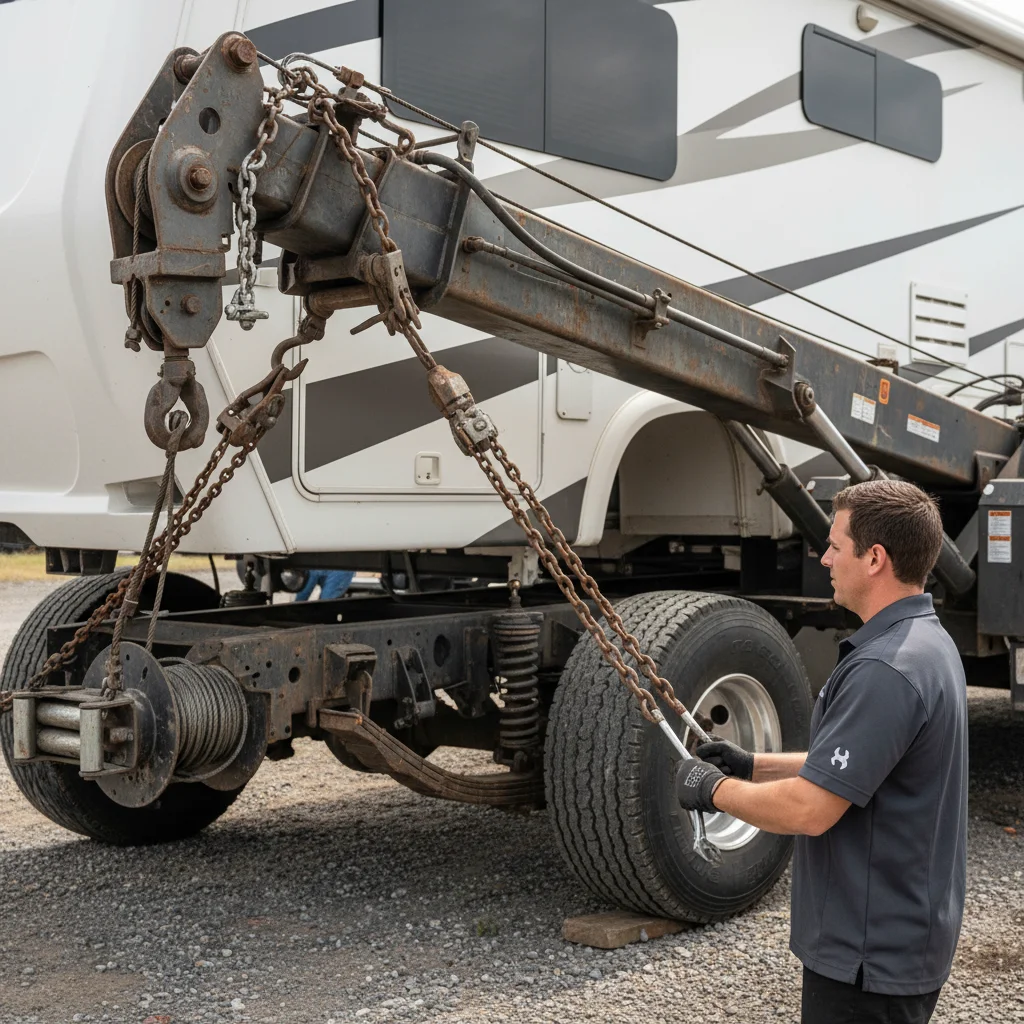
What a proper RV call requires is a medium- or heavy-duty wrecker, typically a 35-ton integrated unit or an underlift/wheel-lift combo built for Class 6–8 chassis. Our heavy-duty towing trucks are spec’d for exactly this: extended booms, wide-set underlift arms, and enough braking capacity to control a 30,000-lb tow on a freeway grade.
If someone quotes you a tow and then shows up in a standard flatbed rated for passenger vehicles, send them home. The risk to your coach isn’t worth it.
Class A, B, C, what each one means for the tow
Not all motorhomes tow the same way, and the class designation matters more than most people realize.
Class A
These are the big coaches, bus-style bodies on a dedicated motorhome chassis or converted commercial bus frame. Gross vehicle weight ratings (GVWR) typically run 26,000–45,000 lbs. A diesel pusher Class A almost always requires a full heavy-duty wrecker with an integrated boom. The wheelbase is long, the rear overhang is dramatic, and the engine is in the back, which changes how the rigging weight distributes.
Class B
Class B camper vans, think converted Mercedes Sprinters or Ford Transits, fall under 11,500 lbs GVWR. Most medium-duty trucks handle these fine, and a flatbed is often the cleanest option if the van has a low-profile body kit or custom bodywork you don’t want stressed.
Class C
Class C motorhomes are built on a cutaway cab chassis (Ford E-Series or Ram ProMaster derivatives). GVWR typically lands between 12,500 and 22,000 lbs depending on length and slide-outs. They’re the most common RV tow call we get in San Diego County. A medium-duty underlift rig works for most Class Cs under 18,000 lbs; anything heavier needs the full heavy-duty setup.
If you’re not sure of your GVWR, it’s on a sticker inside the driver’s door jamb, check it before you call so you can give an accurate number. That single figure determines which truck rolls.
Common RV breakdown points around San Diego County
San Diego’s geography is rougher on RVs than most visitors expect. Several corridors show up repeatedly in our dispatch logs.
I-8 between El Cajon and Pine Valley. The climb from 500 feet to nearly 4,000 feet over about 25 miles pushes cooling systems hard. Overheating, blown coolant hoses, and transmission failures are common, especially in summer. The shoulder narrows significantly near the Viejas grade. If you break down here, stay in the cab with seatbelt on until help arrives, CHP guidance on highway breakdowns is worth knowing.
SR-76 between Oceanside and Pala. A popular entry corridor for snowbirds and weekend travelers coming down from Riverside and Orange counties. Two-lane sections with no real shoulder make a breakdown complicated. We cover this corridor out of our North County zone.
I-15 near Miramar and Scripps Ranch. High traffic density means a stopped RV creates an incident fast. CHP typically dispatches a Freeway Service Patrol unit first, but FSP trucks aren’t equipped for RV tows, expect to wait for the right rig.
Campground exits in East County. William Heise, Dos Picos, Cuyamaca, steep, narrow roads that punish soft tires and overloaded frames. Drivers who over-packed before leaving home discover the problem on the way out.
For general freeway breakdown guidance, our post on what to do if your car breaks down on the freeway covers the safety steps that apply to any vehicle, RV included.
What an RV tow costs in 2026
RV towing costs more than car towing, that’s just physics. The equipment is bigger, fuel burn is higher, and the driver skill required to rig a coach without damage is a real differentiator.
Here’s a realistic range for San Diego County in 2026:
- Class B camper van (under 11,500 lbs): $175–$325 for a local tow under 10 miles. Mileage charges typically run $5–$8 per mile after that.
- Class C motorhome (12,500–22,000 lbs): $300–$550 base, plus mileage. A tow from Alpine to a La Mesa dealer or the Kearny Mesa service corridor could run $450–$650 total.
- Class A motorhome (26,000–45,000 lbs): $500–$900+ depending on length, weight, and whether a winch-out or recovery is involved. Complicated extractions, off a soft shoulder, out of a ditch, on a grade, add to the base rate.
After-hours calls (evenings, weekends, holidays) typically add 15–25% to the base rate. That’s industry-standard; it reflects overtime and dispatch costs.
Some RV owners carry roadside assistance through AAA, Good Sam, or FMCA. Those plans can offset costs significantly, but coverage limits on heavy units vary. Know your plan’s weight cap before you need it, many standard plans top out at 10,000 or 12,000 lbs, which excludes most Class As entirely.
For a broader look at tow costs in San Diego, see our guide on how much a tow truck costs in San Diego.
Trailer towing: fifth-wheels, travel trailers, toy haulers
Not every RV breakdown involves a motorhome. Travel trailers, fifth-wheels, and toy haulers are towed behind a separate vehicle, and when something goes wrong, the situation is different.
Trailer blowout or axle failure. A blown tire or broken axle on a travel trailer usually means the tow vehicle is still functional but the trailer is undriveable. You need a truck that can either repair the trailer roadside or transport it separately. If the trailer has dropped a corner onto the pavement, a flatbed is the right call. Our RV & trailer towing service handles these regularly.
Tow vehicle breakdown with trailer attached. This one’s complicated. The tow vehicle needs a tow, but it’s still hitched to a 10,000-lb trailer. You may need two trucks, one for the trailer, one for the tow vehicle, or a single heavy-duty unit that can take both. Tell us upfront what’s attached so we send the right equipment the first time.
Fifth-wheel specifics. Fifth-wheels are heavy, 12,000–20,000 lbs is common for a full-size unit. They also sit high, which affects boom rigging. Toy haulers in the same weight range add the complication of an interior ramp and cargo load that shifts the center of gravity backward.
Weight matters here just as much as with motorhomes. Know your trailer’s GVWR before you call.
When to ask for a flatbed transport instead
Flatbed transport isn’t always the right answer for RVs, the length and height of most motorhomes simply doesn’t work on a standard 48-foot flatbed. But there are situations where a flatbed-style transport makes sense.
Class B vans under 22 feet often load cleanly onto a heavy-duty flatbed or rollback. If the van has a front-wheel-drive powertrain and can’t be towed in wheel-lift configuration without risking the transaxle, flatbed is the correct choice. The same logic applies to any RV with a seized drivetrain or locked brakes.
Some dealers and repair shops in the San Diego area, particularly in the Kearny Mesa auto corridor and around the La Mesa area, prefer flatbed delivery because it simplifies the handoff. If you’re moving a non-running coach to a storage facility or consignment lot, flatbed transport is worth asking about.
Our flatbed towing page covers what fits and what doesn’t. If your RV falls into a gray area, call and describe the unit, we’ll tell you straight which truck makes sense.
When to call us
RV and trailer tows aren’t the job for whoever picks up first. You need the right weight class of truck, a driver who knows how to rig a coach without causing damage, and a company that dispatches promptly when you’re stuck on a grade in East County or blocking a campground exit. Call us at (858) 923-5787 for a same-day estimate.