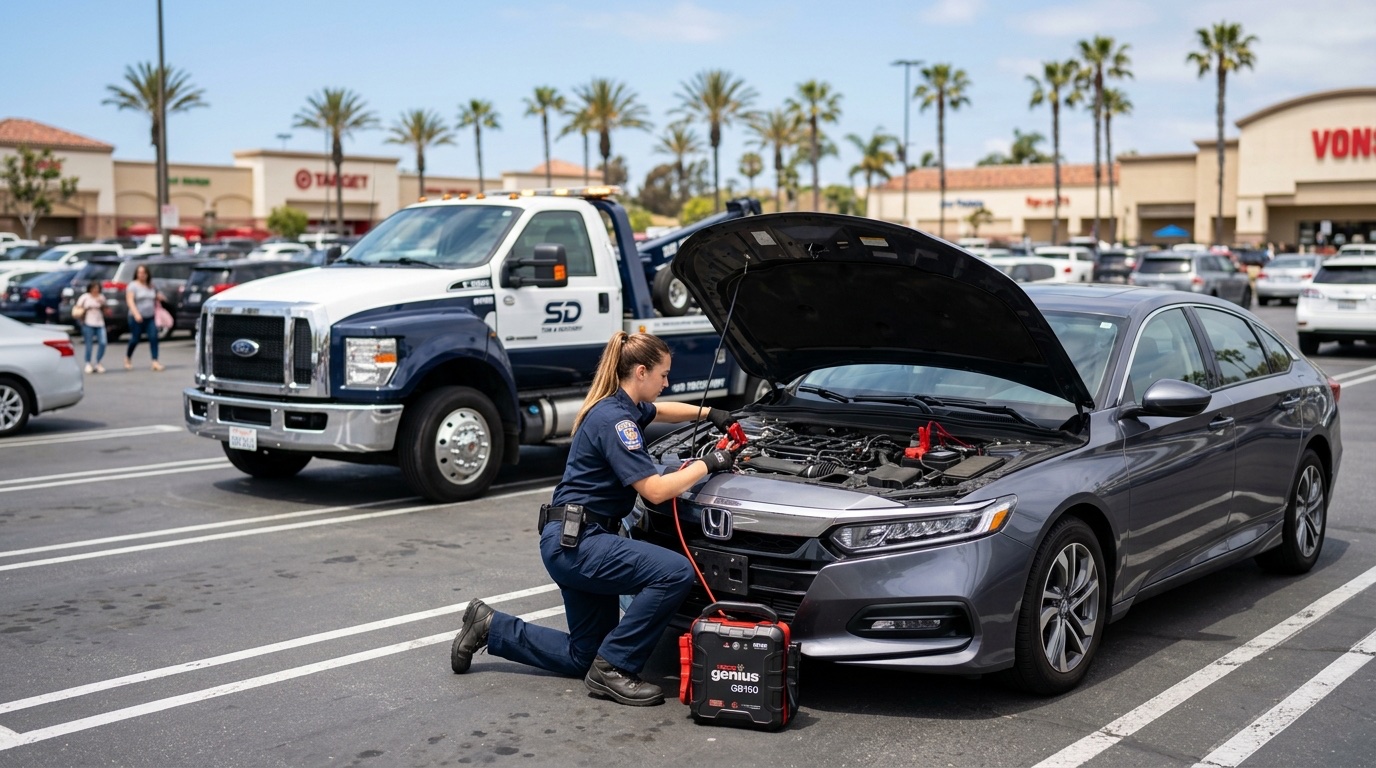
A mobile jump start in San Diego is a flat-rate roadside call, quoted before anyone gets dispatched, so you know the price before the truck rolls. AAA members usually pay nothing for it because it’s covered by their membership, up to their yearly call limit. If you’re not a member, you pay per incident, and the typical San Diego range runs about $50 to $150, with most straightforward calls landing near $50 to $75. The exact number depends on a few things we’ll walk through below.
That’s the short answer. Here’s how the price actually gets set, when a jump won’t be enough, and why San Diego batteries die more often than people expect.
What drives the price of a jump start
Three things move the number on a jump start, and one popular myth doesn’t.
The time-of-day surcharge myth. A lot of national pricing guides warn about after-hours and weekend surcharges, where a $50 daytime call becomes $100 at midnight. Quick Tow doesn’t run a surge model. A 2 a.m. jump start in Pacific Beach is priced the same way as a 2 p.m. one. You still get the quote before dispatch, so a dead battery at a bad hour doesn’t turn into a worse bill.
Distance to you. A roadside call has to physically reach your car. A jump in a Hillcrest parking garage that’s ten minutes from the truck costs less to dispatch than one out past Alpine or near the East County grade on I-8. The closer and more accessible your car is, the lower the call. Underground garages, gated lots, and freeway shoulders take longer to get to and work in, and that shows up in the quote.
Dead battery versus a deeper fault. A jump start fixes one specific problem, a battery that’s drained or weak. If the real issue is a dead alternator, a failed starter, corroded cables, or a parasitic drain, the jump may not hold, or the car won’t take a charge at all. In that case you’re not paying for a jump anymore, you’re looking at a tow to a shop. A good roadside tech can usually tell the difference on site and won’t charge you for a jump that was never going to work.
Jump start versus needing a tow
A jump start and a tow solve different problems, and knowing which one you need saves money.
A jump works when the battery still holds a charge but doesn’t have enough cranking power right now, usually because you left a light on, the car sat too long, or the battery is just old. You get a boost, the engine catches, the alternator takes over, and you drive off.
A jump won’t hold when the charging system itself is the problem. If your car starts on the jump and then dies the moment the cables come off, the alternator probably isn’t charging the battery, and no amount of jumping fixes that. Same story if the battery is fully failed and won’t accept a charge, or if there’s an electrical fault somewhere in the system. At that point the car needs to get to a shop, and that’s a tow, not a jump. If you want to understand how tow pricing works, we break it down in our tow cost San Diego guide.
The honest rule of thumb: a jump start is almost always cheaper than a tow, so it’s worth trying first. But if the jump doesn’t hold, paying for a second jump is throwing money away. Get it towed.
The San Diego context, why batteries die here
San Diego has a reputation for mild weather, and that’s exactly why people get caught off guard by dead batteries. The real enemy of a car battery isn’t cold, it’s heat, and we get plenty of it.
Heat shortens battery life. High temperatures speed up the chemical reactions inside a battery and evaporate the fluid, which wears it out faster than cold ever would. During Santa Ana events, when hot, dry winds push inland temperatures up, and through the long inland heat that builds toward El Centro and the desert edge, batteries take a beating. A battery that might last five years in a cool climate can give out a year or two early here, often with no warning, just a click in a parking lot.
Marine air corrodes terminals. Closer to the coast, in places like Point Loma, Ocean Beach, and Coronado, salt-heavy marine air corrodes battery terminals. Corroded terminals can’t pass current cleanly, so even a healthy battery can act dead, and a jump may not connect well until the terminals are cleaned.
Common breakdown spots. We get a lot of jump calls from beach lots after long days at the water, from park-and-ride and trolley lots where cars sit untouched for hours, from office garages downtown and in Kearny Mesa, and along the I-5, I-8, and I-15 corridors. If your car’s been sitting in the sun or hasn’t moved in a while, a dead battery is one of the most common ways a San Diego day goes sideways. Our dead battery statistics post shows just how often this happens.
Cost comparison, your four options
When the battery’s dead, you’ve got four basic ways to deal with it. Here’s how they stack up.
AAA membership. Membership covers a set number of free service calls per year, jump starts included, often four. If you stay under that limit, the jump itself feels free because you already paid through the annual fee. Once you pass the limit, you typically pay around $100 per call, and there’s usually a fee, around $75, if you try to use a brand-new membership in the first 48 hours. Membership makes sense if you break down often. If you need help once or twice a year, the math is closer than people assume.
Dealer or mobile mechanic. A mobile mechanic visit for a jump or battery test commonly runs $50 to $150, sometimes more if they’re also diagnosing a charging issue. This is overkill for a simple dead battery but useful if you suspect a deeper electrical fault.
Local roadside call. A direct roadside jump in San Diego typically runs about $50 to $150, with most calls near $50 to $75, quoted before dispatch. No membership, no annual fee, you pay only when you actually need it. For drivers who rarely break down, this is usually the most honest deal.
DIY jumper cables. A set of cables costs about $20 to $40, and a portable jump pack runs $60 to $120. If you know how to jump start a car safely and have a second car or a charged pack, this is the cheapest option. The catch is you need another vehicle or a charged battery pack on hand, and modern cars with sensitive electronics are easy to damage if cables go on backward. If you’re not sure, don’t guess.
Frequently asked questions
How much is a jump start without AAA in San Diego?
Without a membership, a local roadside jump start in San Diego typically runs about $50 to $150, with most straightforward calls landing near $50 to $75. The exact price depends on how far the truck travels and how accessible your car is. At Quick Tow you get the quote before dispatch, with no time-of-day surge.
Why won’t my car start after a jump?
If the engine catches on the jump and then dies once the cables come off, the alternator probably isn’t charging the battery. If the battery won’t take a charge at all, it may be fully failed, or there’s an electrical fault. Corroded terminals, common near the coast, can also block a clean connection. In these cases the car needs a tow to a shop, not another jump.
Is a jump start cheaper than a tow?
Almost always, yes. A jump start is a single roadside service, while a tow involves a truck, loading, and mileage to a shop. Try the jump first. But if the jump won’t hold, a second jump is wasted money, and a tow is the right call. See our tow cost San Diego breakdown for tow pricing.
Does heat kill car batteries faster in San Diego?
Yes. Heat is harder on batteries than cold because it speeds up the internal chemical reactions and evaporates fluid, wearing the battery out early. Santa Ana events and inland heat toward the desert edge make San Diego batteries fail sooner than the mild-weather reputation suggests, often a year or two ahead of schedule.
Can a jump start damage my car?
Done correctly, no. Done wrong, yes. Reversed cables or a careless connection can fry sensitive electronics on modern vehicles. That’s why a clean, correct connection matters, and why a roadside tech who does this all day is a safer bet than a stranger in a parking lot who isn’t sure which clamp goes where.
Stuck right now?
If your car won’t start and you’re somewhere in San Diego County, call Quick Tow at (858) 923-5787. You’ll get the price before the truck rolls, and if it turns out you need a tow instead of a jump, we’ll tell you straight. You can also read more about mobile jump start service near me or our jump start service page for what’s included.