You’re on the side of Sunrise Highway with a dead bike and a single bar of LTE. The question isn’t whether roadside assistance exists, it’s whether what you signed up for actually covers a motorcycle, and whether anyone can reach you before dark.
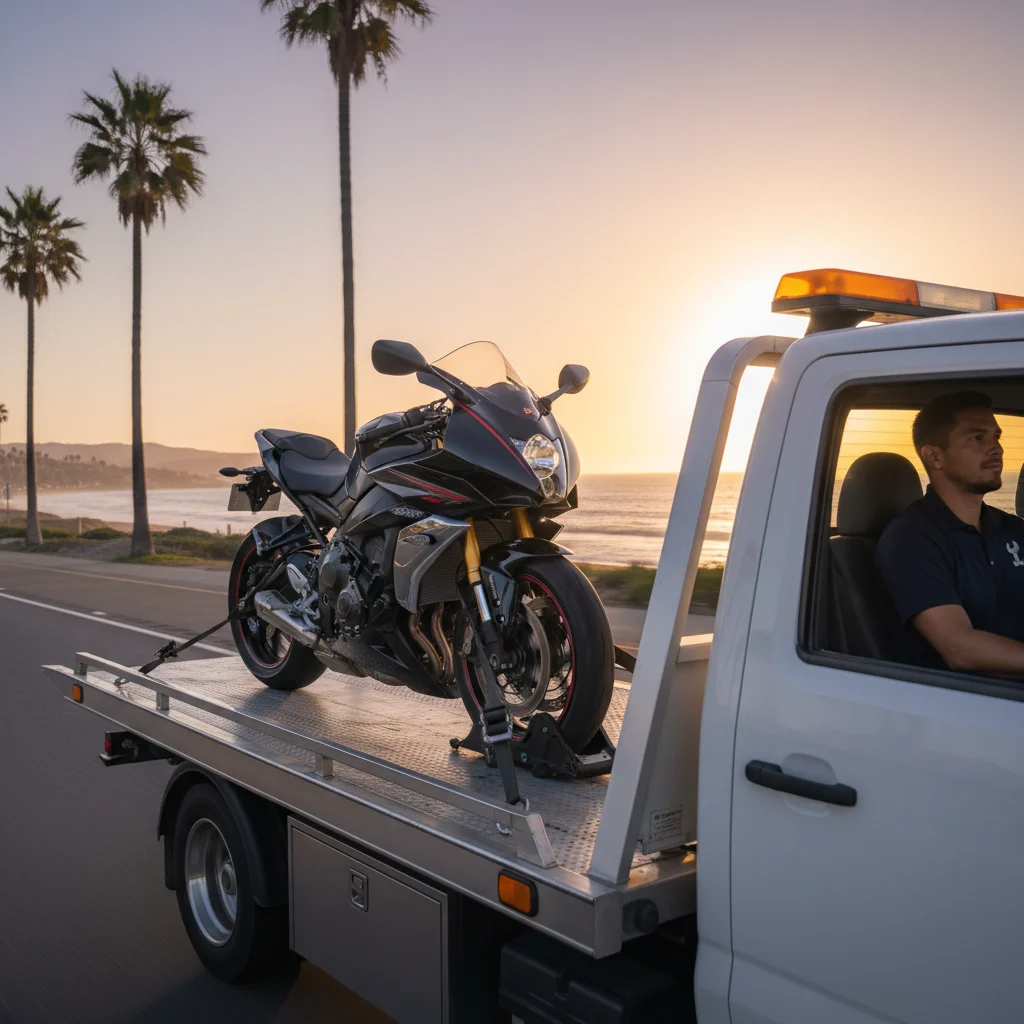
Why most roadside plans fail motorcycle riders
Most drivers buy roadside assistance for their car and assume it covers the bike in the garage. It usually doesn’t, or if it does, the coverage is so stripped-down it’s nearly useless when you’re actually stuck.
Here’s what riders run into when they call the big national plans:
Motorcycle isn’t listed on the policy. AAA’s standard membership covers motorcycles for towing, but only if the bike is registered as a covered vehicle. If you added it as an afterthought, or forgot to list it at all, the dispatcher may tell you you’re not covered. AAA’s roadside assistance overview spells this out, it’s easy to miss during signup.
The dispatched truck can’t actually load a bike. This is the bigger problem. National plans dispatch whoever is available. That’s often a wheel-lift truck built for four-wheeled vehicles. The driver may not carry soft straps or a wheel chock. Some will attempt to load your bike anyway. That’s when paint gets scratched and forks get stressed.
Coverage caps out too soon. Entry-level plans may cover 5 or 10 miles of towing. A breakdown on Palomar Mountain puts you 30-plus miles from most shops. You’ll owe the difference, often more than just calling a local company outright.
Response times are estimated from a call center, not from the field. The national app says 45 minutes. The sub-contracted local truck says 90. You’re splitting the difference on a mountain road with no shade.
The gap between what a plan promises and what shows up is wide. Knowing what real motorcycle-specific service looks like makes it easier to choose before you need it.
What real motorcycle roadside assistance includes
Good motorcycle roadside assistance covers four things: a truck that can safely load your bike, a driver who knows how to do it, enough towing distance to reach a real shop, and an honest ETA based on actual location.
For motorcycles specifically, that means:
A flatbed with tie-down hardware. Not a wheel-lift. Not a flat hook dragging a car dolly. A proper flatbed deck with a wheel chock and soft-tie straps rated for your bike’s weight. More on that in the next section.
A driver who’s loaded bikes before. Loading a motorcycle isn’t intuitive. The balance point shifts when the front wheel is chocked. An experienced driver positions the chock, runs straps from the lower frame or axle points, and checks tension without over-compressing the forks. First-timers guess. You can tell by how long it takes and where they reach for.
Fuel delivery or jump-start if that’s all you need. Not every call is a full tow. If you ran dry on De Anza Springs Road or your battery gave out in a Sorrento Valley parking structure, a good service sends someone who can confirm the problem first before hooking up.
Honest dispatch. A local company can tell you where their nearest truck is. That’s a different conversation than a national call center estimating from a zip code.
Our motorcycle towing service runs dedicated flatbeds, not general-purpose trucks reassigned at the last minute. That distinction matters more than it sounds.
Flatbed vs soft-strap: how your bike should be loaded
This is where a lot of damage happens, not from the breakdown itself, but from the tow.
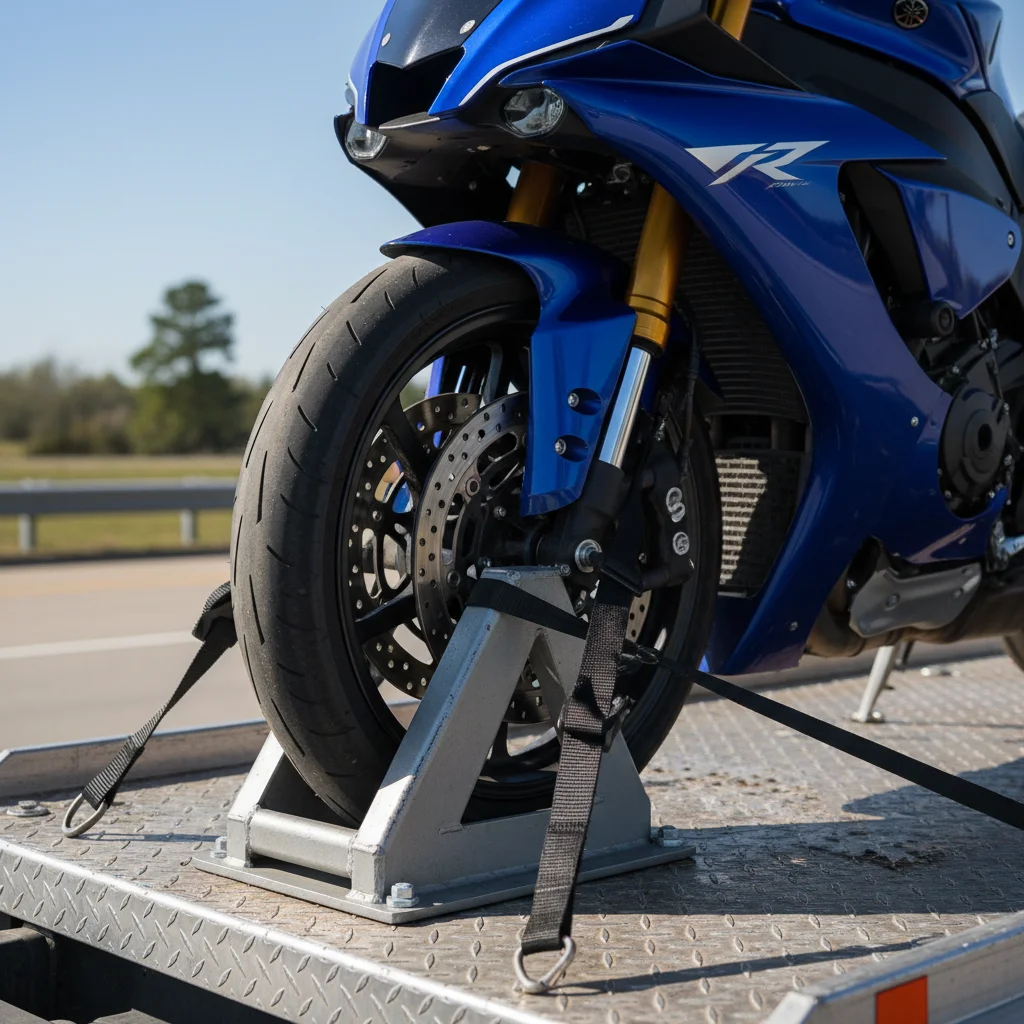
A flatbed is non-negotiable for motorcycles. Wheel-lift towing, where a yoke grabs the rear axle and drags the front wheel along the ground, was designed for cars. On a motorcycle, it puts uneven stress on the rear frame, risks scraping the exhaust, and offers no control over lateral movement. Don’t accept it.
On a proper flatbed, loading should go like this:
Wheel chock first. The front wheel sits in a chock that holds the bike upright and prevents rolling. Without it, the driver is fighting gravity while trying to run straps.
Soft straps at the lower frame or axle points. Not the handlebars. Not the mirrors. Not the bodywork. The straps should anchor at structural points, typically the lower triple clamp, frame loops, or axle sliders. If you see a strap running over a fairing, say something.
No over-tightening. Straps hold the bike from tipping side to side, not from compressing the suspension. Over-tight straps push down through the forks and can pre-load them into a bind. A properly strapped bike feels firm but the suspension still moves slightly.
No frame contact with the deck hardware. The bike’s frame shouldn’t be resting against ratchet buckles, hooks, or deck rails. Every contact point is a scratch waiting to happen on a mountain road.
If you want to go deeper on how this works end-to-end, motorcycle towing done right walks through the full process. And if cost is your primary question before you call, what motorcycle towing costs in San Diego has current rate ranges.
San Diego canyon and coast routes where riders break down most
San Diego is a great county to ride in and a specific one to break down in. Some stretches are more isolated than they look on a map.
Sunrise Highway (S-1). The climb out of Pine Valley toward Mount Laguna sits above 5,000 feet. Cell coverage drops out through long stretches. Overheating is common in summer. If you’re not on Verizon or AT&T, you may have no signal at all near the Laguna Meadows trailheads. Our coverage in that corridor is covered from the Pine Valley dispatch area.
Palomar Mountain (S-6 / S-7). The Grade and the East Grade both have steep switchbacks, limited pullouts, and spotty signal. A breakdown near the observatory puts you a long way from any shop. Overheating, vapor lock, and tire issues are common on the climb.
PCH through Del Mar and Torrey Pines. The coast route seems accessible, but a breakdown near Torrey Pines State Reserve can back up traffic fast. The freeway breakdown guide applies here, get off the travel lane, stay behind the barrier, and call before you try to push.
Sorrento Valley and Miramar corridors. High-volume commuter routes. Riders break down here more often than the canyon routes simply because of the volume. The good news: faster response times because we’re closer.
S-2 through Anza-Borrego approaches. Once you drop into the desert side, you’re 45-plus miles from most services. NHTSA’s roadside safety guidance recommends staying with your vehicle, on these stretches, that’s especially true.
Knowing your route in advance helps. Downloading an offline map before heading into the mountains is worth the three minutes it takes.
What it costs and how fast we get there
Pricing for motorcycle towing in San Diego County typically runs in the range of $75–$125 for a standard hookup fee, plus a per-mile rate after the first few miles. Exact numbers depend on pickup location, destination, and time of day. Full cost breakdown here.
What affects your bill:
- Distance. A tow from Palomar Mountain to a shop in Escondido is 30-plus miles. That adds up faster than a tow across Mira Mesa.
- After-hours calls. Midnight on a Saturday versus 10 a.m. on a Tuesday, there’s often a difference.
- Access difficulty. If your bike went down on a steep pullout or needs a winch-assisted recovery, that’s different work than a flat-surface pickup.
On response times: we’re honest about it. For most of San Diego proper, North Park, Mission Valley, Kearny Mesa, La Jolla, we’re typically there in 30–45 minutes. Mountain routes like Sunrise Highway or Palomar can run 60–90 minutes depending on where on the road you are. We’ll tell you what we know when you call, not what sounds good.
How to call for help when you’re down to one bar of signal
Low signal is the worst time to learn your plan doesn’t work. A few things that help:
Text over call when signal is weak. SMS compresses more efficiently than voice. If you can’t connect a call, a text to your contact saying your location may go through when a voice call won’t.
Use your GPS coordinates, not a road name. “Sunrise Highway near mile marker 27” is useful. Your phone’s maps app can show you coordinates even on low signal, screenshot it before you lose the last bar.
Call first, app second. Dispatch apps from national plans route through servers. A direct call to a local company like us goes to a person. Fewer failure points.
Save our number before you ride. (858) 923-5787. It takes four seconds now and matters a lot later.
If you have no signal at all, ride or walk to higher ground before you stop, even 200 feet of elevation can open up a connection. San Diego County’s emergency road contacts are also listed at sandiegocounty.gov/roads if you have enough data to load a page.
One more thing: tell someone your route before you leave. If you’re heading up Palomar or running the S-1 loop, a text to a contact with your planned return time costs nothing and has saved riders in those exact canyons.
When to call us
If your bike won’t start, you’ve got a flat you can’t fix roadside, or you’ve gone down and aren’t sure the bike is rideable, don’t risk a bad tow by calling whoever answers first. Motorcycle towing done wrong damages paint, frames, and forks. It needs someone with the right truck and the right experience.
Call us at (858) 923-5787 for a same-day estimate.